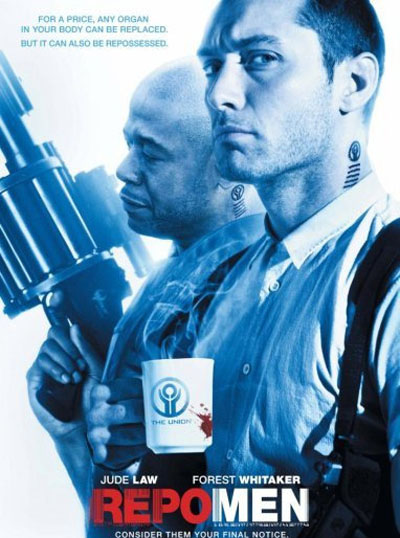
"Repo Men" Jude Law and Forest Whitaker
Ever wanted an artificial limb or organ? They’re fairly expensive, but if you answered yes, you should hope you have good health insurance. Repo Men (in theaters now) approaches the subject of artificial transplantation by creating a dystopian world where a single private company, The Union, controls the market of artificial survival. The inability for transplant patients to afford payments, and how quickly and earnestly The Union takes back their artificial limbs (which in theory becomes legalized murder) creates a unique twist on contemporary privatized repossession.
Jude Law plays Remy, a “Repo Man,” sent from home to home to repossess artificial organs that their users can no longer afford. He must set an emotional distance during his job so he can adequately cut out mechanical lungs and hearts. Circumstances turn Remy upside down, as he is given his own artificial heart, and must fight the other Repo Men as his payments fail to turn up.
Through satisfying action scenes and a close friendship between Jude Law and Forest Whitaker that slowly weaves through a fairly predictable plot, the movie surprisingly shines above most modern action films. Although it falls victim to the over-used surprise twist ending, the dystopian fairy tale turns focus on many contemporary ideas of repossession.
Remy finds his life being taken from him, and it is almost surprisingly that his home isn’t physically repossessed. The current American economy has become a feeding ground for privatized repossession companies, and as cars are taken from the banks and mortgage companies repossess homes to replace them on the market, the destruction of the family life becomes relevant.
In Repo Men, Remy tries desperately to make a compromise with his wife and save his family, mainly for his younger son. It is clear, however, that this will not happen. The question then becomes clear: where do you draw the line between financial insecurity and financial destruction?
Some of the artificial organs in the film cost upwards of $600,000, and it’s easy to imagine this is how much financial weight some American families may have due to the escalating economic terror. We sympathize with Remy because his financial situation and the unemotional response from The Union is all too real. Does the bank send Repo Men to collect your car, and apologize profusely for having to do so? Of course not; these are hired guns without the ammunition. Cold, calculated, and hired for one purpose: to disconnect themselves from the emotion of reality, and to take back what someone else cannot pay for. And, as always, done in a legal manner that is beneficial to the private company.
 There is no financial unrest for The Union in Repo Men. In fact, it is entirely plausible that this company controls vast quantities of the economy. It seems as though the normal citizenry, sitting under the eyes of The Union, are all forced to buy these artificial limbs and organs because there are no other choices. Break your foot? Artificial limb. Need a new kidney? Artificial organ. The people are pigeonholed into a catch-22, one that is only escapable by death.
As the film progresses, Remy’s chances for success and redemption become bleaker. Is this the same fate that Americans must face once repossession is set in motion? If their car or home is taken, and their credit takes a dive, with the financial burdens be too much to achieve future successes, causing them to deal with minimum wage amid the crumbled economy?
The film sets in motion the idea of paranoia and fear over family life. The provider of a family is dedicated to deliver the American Dream, which in any dystopian film is conveniently destroyed. As repossession becomes more and more of a privatized business, which is a concept Repo Men is presenting, the ability to conquer the American Dream and provide for the family is beyond grasp. And who is to blame? The individual or society? Repo Men argues the idea that an individual is not in control, and in their weakest and most vulnerable moments the companies strike to bring him/her down. Attempting to achieve the American Dream then causes extreme financial risks, with the Dream ready to crumble at any moment.
In Repo Men, these financial risks lead to demoralized individuals and destroyed family homes, making it nearly impossible to live a fruitful and undisturbed life without flawless health. While watching the film, it’s hard to differentiate between the Repo Men coming to collect your liver, and the Repo Men coming to collect your car.
All in all, the movie was fun. It didn't overstay it's welcome, and the middle lack-of-action didn't seem out of place. It was bloody, as it should have been, and the actors did a great job with what was most likely a mediocre plot. But we weren't expecting Citizen Kane II: the Return of Kane. It was a fun and cool action movie that delivered what it had proposed, and I walked out of the theaters happy.
Rating: 8/10
Extra: Jude Law (among others) needs to accept that he can be an awesome action hero
Check out the new bloggy, boys and girls! (http://cchronicle.com/author/ryan-deziel/)
